
Vietnam has an active trade in used jute bags for agricultural packing and redistribution. Export records show shipments to markets in Africa and other regions, with different sizes, weights and bale configurations depending on the buyer.
For importers, the key point is that “used jute bag” is not a complete purchase specification. A successful order needs measurable product limits and a clear packing method before the container is loaded.
What Sizes Are Actually Seen in Export Trade?
Commercial listings and shipment records show a broad range. Examples include approximately 68 × 112 cm, 70 × 110 cm, 80 × 110 cm, 100 × 80 cm, 106 × 72 cm, 110 × 70 cm and 110 × 74 cm.
Some Vietnam suppliers list 110 × 70 cm purple-striped used bags around 0.86–0.89 kg each and thinner 106 × 72 cm bags around 0.6 kg each. Other export records show 0.8–0.9 kg used sacks for agricultural goods.
These numbers should help a buyer understand market variety. They should not be copied into a purchase order unless they match the intended product.
Define the Bag Before Discussing the Container
Container quantity is often used as a selling point, but the bag specification must come first. A thin 0.6 kg sack compresses differently from a heavy 1.1 kg sack. Moisture, folding and hydraulic pressure also change bale volume.
Before asking “How many pieces fit in a 40HC?”, confirm:
- Bag width and length.
- Average empty weight.
- Fabric thickness or grade.
- Allowed repair level.
- Stripe or identification requirement.
- Pieces per bundle or bale.
- Target bale dimensions and weight.
Typical Bale Packing
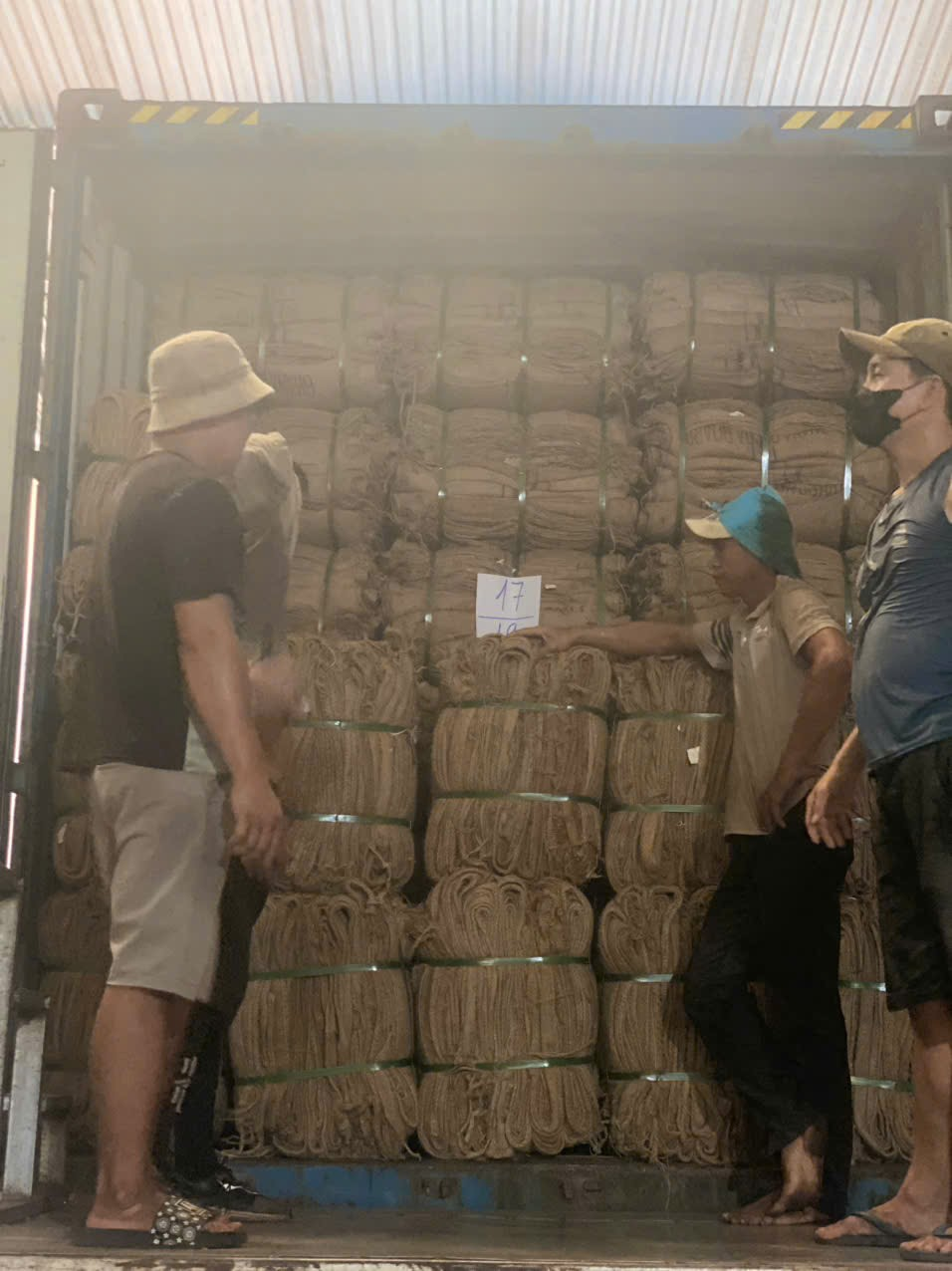
Used sacks are commonly folded, counted and compressed into bales for export. Market examples include bales of 100 pieces, while other jute-industry packing systems use different counts depending on fabric type and bag size.
The purchase contract should state whether count is by actual pieces or estimated bale weight. Piece count is usually clearer when the importer resells individual bags.
Why Container Counts Vary So Much
Published supplier examples show 40HC loads ranging from roughly 30,000 pieces for heavier used sacks to more than 38,000 pieces for thinner sacks. Shipment records also show very large orders packed across multiple containers or as dense bale programs.
A container target should be treated as an estimate until a loading trial confirms the actual bale size. Over-compression can also make unpacking difficult or damage weak used fabric.
Ask for These Loading Details
- Number of bales per container.
- Pieces per bale.
- Average bale weight.
- Bale dimensions after compression.
- Net and gross container weight.
- Photos during loading.
- Final piece-count reconciliation.
Quality Tolerances Need to Be Written Down
Terms such as “good condition,” “70%,” “80%” or “selected” are useful for conversation but too broad for a serious bulk contract. Define the defects that matter.
A buyer can specify, for example, that bags must be dry, free of major tears, free of strong chemical odor, and within an agreed dimensional range. If repaired sacks are allowed, state how many repair stitches or patches are acceptable.
Sampling Before Shipment
Photos are useful, but a small sample taken only from the top of a sorted pile may not represent the full shipment. For larger orders, ask the supplier to inspect multiple bales from different warehouse areas.
A simple inspection sheet can record:
- Measured size.
- Bag weight.
- Visible holes.
- Seam condition.
- Repair count.
- Odor.
- Moisture condition.
- Staining or previous-print markings.
Documents and Import Requirements
Import documentation depends on the destination country and the previous use of the sacks. The buyer should confirm customs classification, used-goods restrictions, fumigation or phytosanitary requirements if applicable, and any local rules for agricultural packaging.
Do not assume that because a used jute bag was exported successfully to one country it can enter another market under the same conditions.
Final Buyer Checklist
- Approve the exact bag specification.
- Agree on defects and repairs.
- Confirm bale count and bale weight.
- Confirm estimated container quantity.
- Request representative lot photos.
- Define inspection and claim procedures.
- Check destination-country import rules before loading.
The safest way to buy used jute bags from Vietnam is to treat the order like an industrial textile purchase. Clear dimensions, grading rules and bale specifications matter more than a generic product name.



Xem thêm
Đặc Điểm Về Bao Bố Cũ Đựng Nông Sản
Concrete Curing Blankets: Benefits and Application Methods
Reusing Burlap Coffee Sacks in Gardening and Landscaping: Practical Uses and Safety Checks
Buying Used Jute Bags in Bulk: How to Calculate Bales, Container Quantities and Inspection Samples
Jute Sandbags for Flood Control: Size, Filling, Placement and Material Checks
Used Jute Bags for Raw Cashew Nuts: How to Choose 80–85 kg Packing
Thin vs Thick Used Jute Bags: How to Match Bag Weight to the Job
Purple-Striped vs Green-Striped Used Jute Bags: Size, Weight and Best Uses