
Thin and thick used jute bags can look similar when they are folded in a bale, but they are not interchangeable for every job. The most useful way to compare them is to consider dimensions, average tare weight, weave condition, seam strength, previous repairs and the amount of handling the filled bag will receive.
Current used-bag listings in Vietnam show the difference clearly. A thin woven export bag may be around 106 × 72 cm and about 0.6 kg, while a thick purple-striped bag may be around 110 × 70 cm and 0.86–0.89 kg. A thick green-striped format may reach roughly 1.1 kg at around 110 × 74 cm.
Thickness Is Not Just a Visual Description
“Thin” and “thick” are commercial descriptions rather than a universal engineering standard. Buyers should convert those descriptions into measurable criteria. Bag weight is particularly useful because two sacks can have similar flat dimensions but very different amounts of jute fiber.
Even then, tare weight alone is not enough. A heavy sack can be wet, contaminated or badly worn. A lighter sack can be perfectly adequate for wrapping or covering. Condition determines whether the available fiber still performs its job.
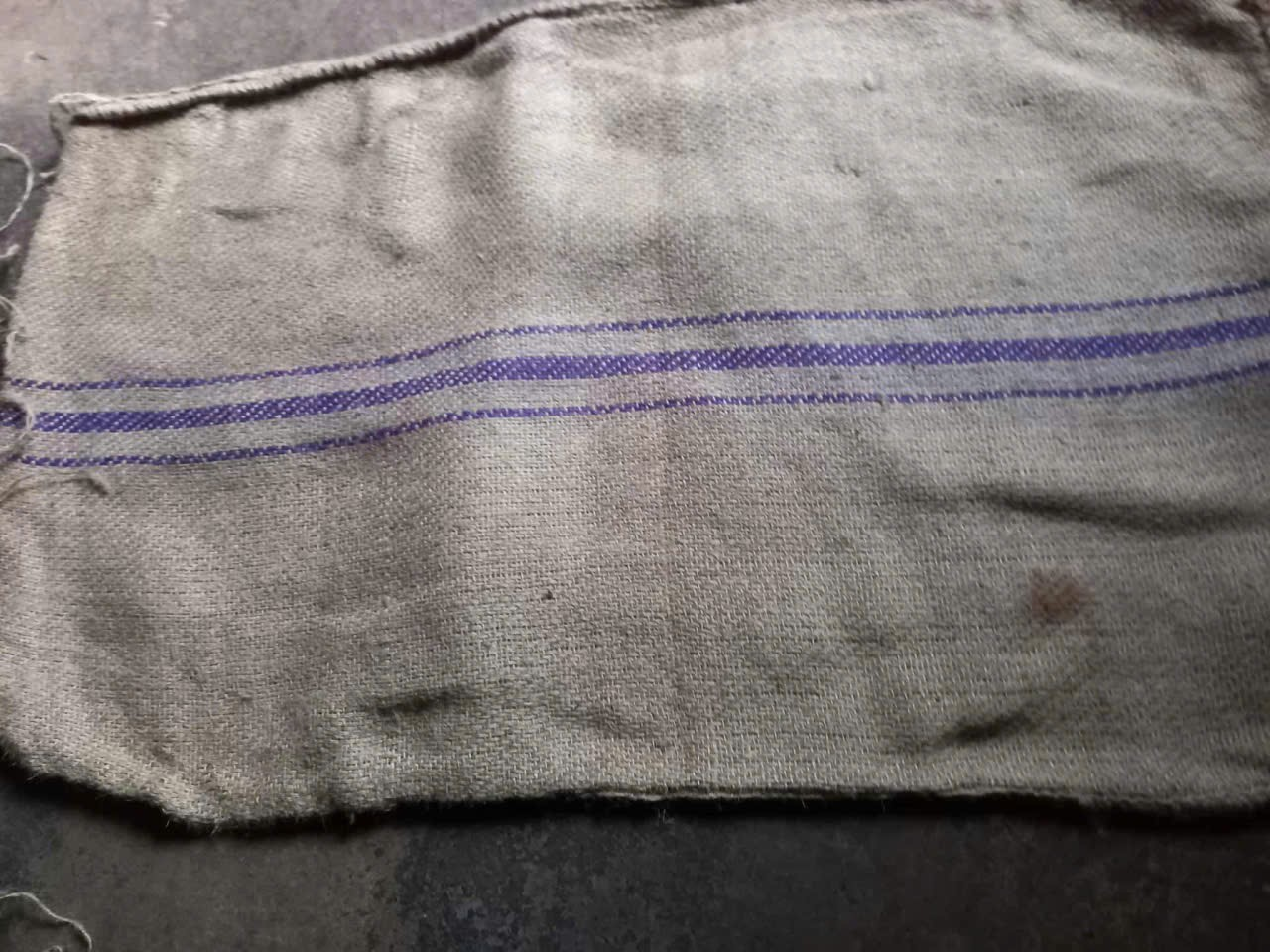
When a Thick Used Jute Bag Is the Better Choice
Thicker sacks are generally more attractive when the bag will be filled, stacked and moved repeatedly. Typical examples include bulk agricultural products, export lots and handling environments where bags may be dragged short distances or compressed in stacks.
A thicker sack can offer more material around the seams and greater resistance to abrasion, but only if the bag is still structurally sound. Look for broken warp or weft yarns, enlarged weave openings and weakened corners.
Typical checks for thick bags
- consistent tare weight across the sample;
- no open tears;
- sound side and bottom seams;
- limited fraying at the mouth;
- repairs that do not reduce usable dimensions excessively;
- dry fiber without mildew or strong odor.
When a Thin Used Jute Bag Makes More Sense
A thin woven sack can be more economical for lighter-duty applications. Examples include wrapping, protective covering, concrete curing, landscaping, temporary storage of lightweight material or agricultural packing where the required load has been tested and confirmed.
Thin sacks are also easier to fold, transport and spread over surfaces. That is useful in construction applications such as wet burlap curing, where water retention and coverage can matter more than the sack’s ability to carry a heavy commodity.
Intact, Repaired and Torn Bags Serve Different Markets
Used jute bags should not be classified only by thickness. Condition creates another layer of grading. An intact thick bag may be suitable for packing, while a repaired bag can still be useful for domestic handling if the repair is strong and acceptable to the buyer.
Torn or heavily worn bags should not be represented as normal packing sacks. They may still have value for concrete curing, protective layers, fiber recovery, landscaping or other applications where containment is not the primary function.
How Repairs Change the Effective Size
Repairing a torn section often requires folding material inward and stitching across it. That can reduce the usable width or length. If a buyer needs a specific filled-bag shape, the purchase order should state whether repaired bags are permitted and how much dimensional reduction is acceptable.
For high-volume filling operations, inconsistent repaired dimensions can slow operators and create uneven stacks.
Match the Bag to the Handling Chain
Think through the complete route of the bag:
- How will it be filled?
- Will the mouth be sewn, tied or folded?
- How far will workers carry it?
- Will it be dragged on concrete or soil?
- How high will filled sacks be stacked?
- Will the bags travel in a truck, container or open warehouse?
- Is the bag expected to complete another reuse cycle?
A sack that performs well for one stationary use may not survive an export logistics chain.
Use a Sample Weight Check for Bulk Lots
Instead of weighing only one bag, take a sample from different bales and calculate an average. Large differences can indicate mixed grades, inconsistent moisture or a combination of thin and thick bags in the same lot.
For example, if a purchase is supposed to be around 0.9 kg per bag but part of the sample is closer to 0.6 kg, the buyer should investigate whether different product grades have been mixed.
The Best Choice Is Application-Specific
Thick used jute bags are usually the better starting point for heavier packing and repeated handling. Thin bags are often more economical for covering, curing, repurposing and lower-stress applications. Neither category is automatically “better.”
The correct purchase specification should combine size, average bag weight, condition, repair tolerance, cleanliness and intended use. That gives the buyer a repeatable standard that is more reliable than choosing by appearance alone.



Xem thêm
Đặc Điểm Về Bao Bố Cũ Đựng Nông Sản
Concrete Curing Blankets: Benefits and Application Methods
Reusing Burlap Coffee Sacks in Gardening and Landscaping: Practical Uses and Safety Checks
Buying Used Jute Bags in Bulk: How to Calculate Bales, Container Quantities and Inspection Samples
Jute Sandbags for Flood Control: Size, Filling, Placement and Material Checks
Used Jute Bags for Raw Cashew Nuts: How to Choose 80–85 kg Packing
Thin vs Thick Used Jute Bags: How to Match Bag Weight to the Job
Purple-Striped vs Green-Striped Used Jute Bags: Size, Weight and Best Uses